What OSHA Actually Requires
Ask a group of workers whether they would rather tie off to a certified or non-certified anchorage, and the answer may seem obvious. Certified sounds safer, but that isn’t what those terms actually tell you. Both approaches can be appropriate for personal fall protection. The important difference is how the anchorage is evaluated and how its required strength is established. It seems like such a simple answer, but most workers who use fall protection on a daily basis do not know the difference. In this article, we’ll take an in-depth look at the differences between these anchorage terms and what OSHA sets as the standard for them.
OSHA Doesn’t Use “Certified” and “Non-Certified” as Its Two Regulatory Categories
The terms certified anchorage and non-certified anchorage are commonly used in fall-protection training and industry discussions. OSHA’s construction standard, however, does not divide anchorages into two categories using those names. Instead, OSHA provides two ways an anchorage can satisfy the personal fall-arrest requirements. OSHA
For purposes of this article, we’ll use the familiar certified/non-certified terminology to explain those two approaches.
The Two OSHA Anchorage Paths
For personal fall-arrest equipment in construction, an anchorage must be independent of any anchorage used to support or suspend a platform and must meet one of two requirements:
Option 1: The anchorage is capable of supporting at least 5,000lb for each employee attached
Option 2: An engineered complete system. Instead of using the 5,000-lb criterion, the anchorage can be:
- Designed, installed, and used as part of a complete personal fall-arrest system
- Designed so the system maintains a safety factor of at least two
- Used under the supervision of a qualified person
Those requirements come directly from OSHA’s construction fall-protection standard, 29 CFR 1926.502(d)(15). OSHA
General industry’s 29 CFR 1910.140(c)(13) provides the same basic choice: 5,000 lb per employee attached or a complete system maintaining at least a 2:1 safety factor under the supervision of a qualified person.
What Is Commonly Called a Non-Certified Anchorage?
In fall-protection training, the first approach is commonly discussed as a non-certified anchorage.
The important number is:
5,000 LB PER EMPLOYEE ATTACHED
This is the prescriptive OSHA strength requirement. That does not mean workers should walk onto a jobsite and choose anything that appears capable of supporting a large load. A beam may look strong. So might a pipe, railing, column, piece of equipment, or other structural component. Appearance doesn’t establish anchorage capacity.
“It looks strong enough” is not an anchorage evaluation.
The anchorage still needs to meet applicable requirements and be appropriate for the fall-protection system in use.
What Is Commonly Called a Certified Anchorage?
There are situations where an obvious 5,000-lb anchorage isn’t available, or where the application is better addressed through a designed fall-protection system. In situations such as these, the anchorage can be designed and used as part of a complete personal fall-arrest system. Systems that maintain a 2-to-1 safety factor under the supervision of a qualified person are referred to as a certified anchorage. OSHA
Instead of simply relying on the generalized 5,000-lb criterion, the anchorage is evaluated as part of the complete system. That evaluation considers the forces the system is expected to experience. OSHA has specifically explained that, under the construction alternative, the safety factor of at least two applies to the maximum fall-arresting force of the personal fall-arrest system. OSHA
That means “certified” does not simply mean “stronger.” It means the anchorage is being addressed as part of a designed system.
5,000 lb vs. 2:1: A Simple Comparison
| 5,000-lb Approach | Engineered 2:1 Approach | |
|---|---|---|
| Basic requirement | 5,000 lb per employee attached | Complete system maintains at least a 2:1 safety factor |
| System engineering required by this provision | No engineered alternative being used | Yes |
| Qualified-person supervision specifically required by this provision | Not stated in §1926.502(d)(15)’s 5,000-lb option | Yes |
| Automatically safer? | No | No |
| Key question | Does the anchorage meet the prescribed requirement? | Does the complete system meet the engineered requirement? |
The two paths come from OSHA’s anchorage requirements; the certified/non-certified labels are industry terminology used to describe them, rather than the category names OSHA uses in the regulation.
Does “Certified” Mean Safer?
This is probably the most important point in the entire discussion. A properly evaluated anchorage that satisfies OSHA’s 5,000-lb-per-employee requirement can be completely appropriate. An engineered anchorage used as part of a system maintaining the required safety factor can also be completely appropriate.
The word certified by itself doesn’t tell you that one setup is safer than another.
What matters is whether the anchorage is appropriate for:
- The fall-protection system
- The number of workers
- The equipment being used
- The anchorage location
- The work being performed
The goal isn’t to find the anchorage with the better-sounding label; it is to use the right anchorage for the application.
What Is a Qualified Person?
This is especially important when discussing OSHA’s engineered alternative. OSHA defines a qualified person as someone who, through a recognized degree, certificate, professional standing, or extensive knowledge, training, and experience, has demonstrated the ability to solve or resolve problems relating to the subject matter, work, or project. OSHA
Notice that OSHA says qualified person. It does not universally say that the person must be a professional engineer. An engineer may certainly qualify, depending on the application, but OSHA’s definition is broader than a specific job title.
What About a Competent Person?
OSHA defines a competent person differently. A competent person is someone capable of identifying existing and predictable hazards and who has the authority to take prompt corrective measures to eliminate them. OSHA In simple terms:
Competent Person: Recognizes hazards and has authority to correct them.
Qualified Person: Has demonstrated technical ability to solve problems related to the work or system.
Those roles can overlap, but the definitions are not interchangeable. One technical point is important here: OSHA’s §1926.502(d)(15) does not specifically say that the 5,000-lb anchorage option must be selected by a competent person. By contrast, the engineered alternative explicitly requires supervision by a qualified person. OSHA
That distinction should be preserved when teaching the requirement.
A Strong Anchor Can Still Be in the Wrong Place
This is worth repeating.
Strength alone does not make an anchorage location appropriate.
Consider an anchorage that easily satisfies the required load but creates:
- Excessive free fall
- A severe swing-fall hazard
- Insufficient clearance
- Edge exposure
- An incompatible connector arrangement
The strength number may be acceptable while the overall system is not. That’s why anchorage selection needs to be considered as part of the complete fall-protection plan.
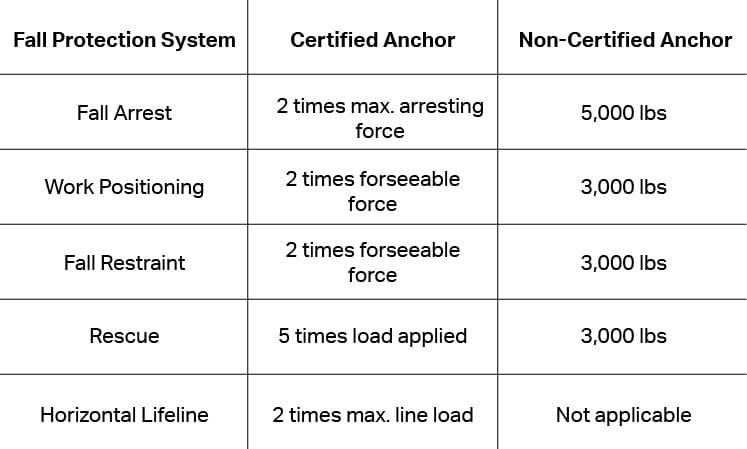
Additional Fall Protection System Anchorage Requirements.
Depending on your application, your certified/non-certified maximums may be different. Use the chart below to determine the requirements.
Before You Tie Off: Anchorage Checklist
Before connecting a personal fall-protection system, verify the complete setup.
Ask:
- Has this location actually been evaluated as an anchorage?
- Does it meet the applicable strength or engineered-system requirement?
- How many employees will be attached?
- Is the connector compatible with the anchorage?
- Is the anchorage independent of a platform-support anchorage where OSHA requires it?
- Will the location minimize unnecessary free fall?
- Could the worker experience a swing fall?
- Could the lifeline or lanyard encounter an edge?
- Is there sufficient clearance below the worker?
- Does the setup follow the equipment manufacturer’s instructions?
- Has the equipment been inspected before use?
OSHA requires personal fall-protection systems and components in general industry to be inspected before initial use during each workshift, with defective components removed from service.
We hope this clears up the question of certified vs. non-certified anchors. Check out FrenchCreek’s inventory of fall protection anchors, and feel free to give us a call at 814.437.1808 with any questions.