Confined space tripods are a critical piece of safety equipment for workers entering manholes, tanks, vaults, and other permit-required confined spaces. The Occupational Safety and Health Administration (OSHA) has established specific requirements for confined space tripods and retrieval systems to protect workers during entry, descent, and emergency rescue. As a manufacturer of fall protection equipment, FrenchCreek Fall Safety has put together this guide to help employers and safety managers understand the regulations and select the right equipment.
What is a Confined Space?
OSHA (Occupational Safety and Health Administration) defines a confined space as a space that meets the following criteria:
- Is large enough and so configured to allow an employee to physically enter and perform their work; and
- Limited Means of Entry or Exit: Confined spaces have a restricted number of entry and exit points, which can make it challenging for workers to enter or exit quickly in case of an emergency; and
- Not Intended for Continuous Occupancy: These spaces are not designed for continuous human occupation due to their nature, such as tanks, vessels, pipelines, or underground areas.
It is important to note that OSHA’s definition of a confined space is not limited to physical characteristics alone but also includes the potential hazards that may be present within the space. Under such circumstances, OSHA mandates a permit for entry into confined spaces. Permit-required confined spaces must meet the aforementioned requirements and possess one or more of the following characteristics:
- Containing hazardous substances
- Lack proper ventilation
- Pose risks such as engulfment, entrapment, or hazardous atmospheric conditions.
- Contains any other recognized serious safety or health hazard
By identifying and properly classifying confined spaces, employers can implement necessary safety measures to protect workers who may need to enter and work in these areas. Confined space tripods serve as essential equipment in such environments, providing stability and safe access for workers. Understanding the OSHA requirements for confined space tripods is crucial for employers and workers to ensure optimal safety during operations.
What is a Confined Space Tripod?
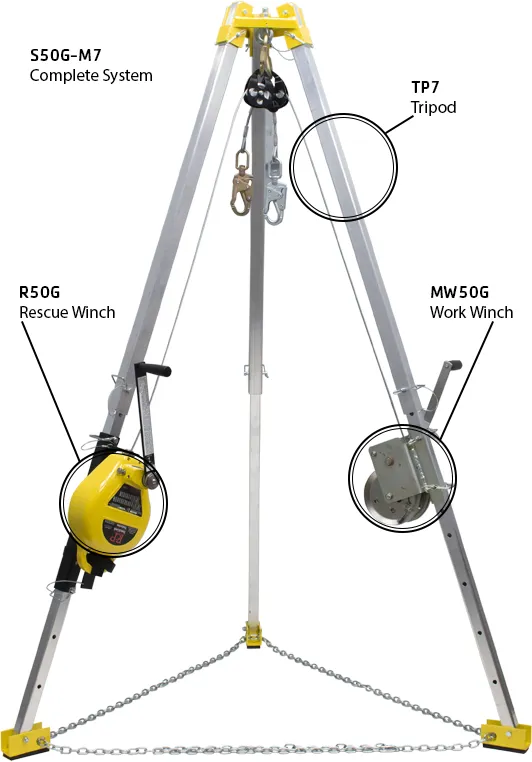
A confined space tripod is a specialized piece of equipment designed to support workers and facilitate rescue operations in confined spaces. It consists of three extendable legs, a head assembly, and attachment points for additional equipment such as winches and self-retracting lifelines. Our confined space tripods — including the S50G-M7 and S50G-7 systems — are constructed with durability and versatility in mind, meeting ANSI and OSHA standards.
Our tripod systems feature a lightweight aluminum design that ensures easy transportation to any job site. Despite their lightweight nature, these systems are built to withstand a vertical load of up to 5,000 lbs., providing the stability and strength required for both safe descent and emergency rescue.
OSHA 1910.146(k)(3) Regulations for Confined Space Tripods
To guarantee the safe use of confined space tripods, OSHA has established regulations that employers must follow under 29 CFR 1910.146. This is the Permit-Required Confined Spaces standard. While OSHA does not require employers to use a specific confined space tripod, winch, or retrieval system model, 1910.146(k)(3) does establish clear requirements for non-entry rescue and retrieval. Adhering to these guidelines ensures the well-being of workers during both routine confined space entry and emergency rescue operations.
- To ensure effective rescue operations, it is recommended to attach the outer end of the retrieval line to a fixed point or a lifting device. This enables prompt initiation of rescue as soon as the rescuer becomes aware of the need.
- For vertical permit spaces that are more than 5 feet deep, the use of a mechanical device is mandatory. This requirement aims to enhance safety during operations within such spaces.
- It is important to be cautious of power winches and overhead cranes as they can pose risks to workers. If the use of power winches could potentially harm employees, they should not be utilized.
- For depths exceeding 50 feet, it is recommended to employ powered retrieval winches. These winches should be equipped with torque limiters, approximately 450 lbs., to prevent damage to an incapacitated individual during rescue operations.
By following OSHA 1910.146’s guidance, employers can ensure that their confined space retrieval systems are compliant and that workers can be safely recovered in an emergency. FrenchCreek’s tripod systems are paired with a 3-way rescue winch or SRL-R. They are designed to meet all of these retrieval requirements out of the box.
Selecting the Right Confined Space Tripod
Selecting the appropriate confined space tripod is essential for worker safety and efficiency. Employers should consider factors such as the nature of the confined space, the intended use, load requirements, and compatibility with other safety equipment.
Key selection factors include:
- Entry depth: For spaces deeper than 5 feet, a mechanical retrieval device is mandatory. For depths over 50 feet, a powered winch is recommended.
- Workspace conditions: Tripods require a level surface and vertical entry. For offset entries, confined areas with limited overhead clearance, or sloped surfaces, a davit system may be more appropriate.
- Load capacity: Verify the system’s rated vertical load meets your requirements, including worker weight and equipment load.
- Winch requirement: Determine whether a material winch is needed in addition to the rescue unit. Some operations require both simultaneously.
- Portability: If the tripod needs to move between multiple job sites, weight and setup time matter. FrenchCreek’s aluminum tripods are among the lightest on the market.
FrenchCreek Fall Safety offers a range of tripods specifically designed for various confined space applications. Our knowledgeable team can assist in selecting the right tripod to meet your specific needs.
Using a Confined Space Tripod Safely
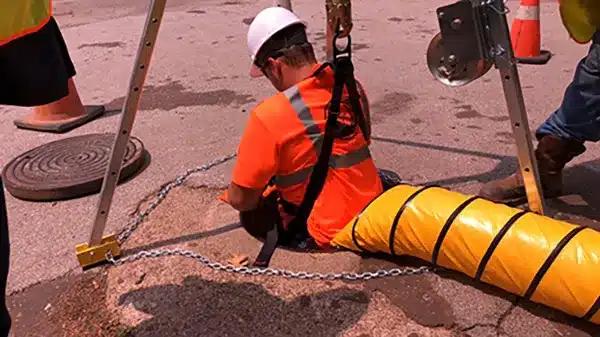
Proper usage of a confined space tripod is crucial for maintaining a safe working environment. Workers should receive comprehensive training on how to set up, secure, and operate the tripod correctly. FrenchCreek Fall Safety provides detailed instructions and training resources to ensure workers understand the proper procedures for using our confined space tripods. Adhering to safety protocols, such as using fall protection systems and avoiding overloading the tripod, is vital for optimal safety.
Training and Competency
OSHA places significant emphasis on training and competency for workers involved in confined space operations. Employers must provide adequate training to employees, covering topics such as confined space hazards, emergency procedures, equipment usage, and rescue techniques.
At FrenchCreek Fall Safety, we offer comprehensive training programs to educate workers on the safe use of our confined space tripods and fall protection equipment.
Emergency Preparedness
Preparing for emergencies is crucial when working in confined spaces. Employers should establish effective rescue procedures, including the availability of personnel trained in confined space rescue operations. It is essential to have rescue equipment readily available, ensure communication systems are in place, and conduct periodic drills to test emergency response capabilities.
We invite you to watch the instructional video demonstrating the proper usage of a confined space tripod for rescuing a fallen worker. In this video, you will learn valuable techniques on how to effectively employ the tripod as a lever to safely extract an incapacitated worker from a confined space.
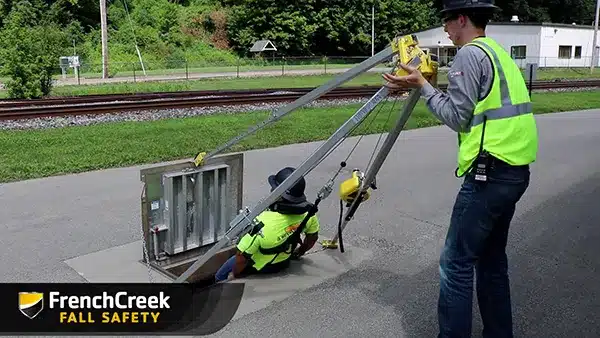
By observing the step-by-step instructions provided, you will gain essential knowledge on utilizing the tripod’s leverage to facilitate the rescue process. This demonstration emphasizes the importance of employing the tripod as a reliable and effective tool in confined space rescue scenarios. Safety is paramount, and by following the guidelines presented in the video, you can confidently respond to such critical situations.
Please click the following link to access the instructional video: VIDEO
Confined Space Tripod vs Davit System: Which Do You Need?
Tripods and davit systems are the two most common solutions for confined space entry and rescue. Understanding the difference helps you select the right system for your specific application.
Confined space tripods are the go-to choice for standard vertical entries like manholes, utility vaults, and tanks with open-top access. They are fast to deploy, self-supporting, and do not require a fixed base. Because they stand independently over the entry point, they provide a centered overhead anchor which is the safest configuration for vertical descent and rescue.
Davit systems are better suited for situations where headroom is limited, the entry point is offset, or a permanent installation is preferred. Davits mount to a portable base or fixed floor sleeve and can reach over railings, walls, or obstructions that a tripod cannot straddle.
Use a tripod when: the surface is level, entry is vertical, the space is portable-access, and setup speed matters.
Use a davit when: the entry is offset or obstructed, the installation is permanent, or the overhead clearance is restricted.
FrenchCreek manufactures both systems. View our full lineup of confined space entry and rescue equipment: Confined Space Entry Systems.
Confined Space Tripod Inspection: What to Check Before Every Use
OSHA 1910.146 requires that rescue equipment be maintained in a serviceable condition. Before deploying a confined space tripod, inspect the following:
- Legs and locking mechanisms: Confirm all three legs extend and lock securely at the intended height. Verify locking pins are fully seated.
- Head assembly: Check for cracks, deformation, or corrosion at the attachment points. Ensure carabiner attachment loops are undamaged.
- Safety chain: Confirm the safety chain is present and properly connected to all three legs.
- Rubber feet: Inspect non-slip rubber safety shoes for wear or damage. Damaged feet can allow leg slippage on hard surfaces.
- Winch or SRL-R: Test the winch crank under light load. Verify the self-retracting lifeline extends, retracts, and locks correctly.
- Documentation: Record each inspection in the equipment log per manufacturer requirements.
Any damaged component should be removed from service immediately. Contact FrenchCreek for replacement parts or service information.
Let’s Wrap It Up
At FrenchCreek Fall Safety, we prioritize worker safety and offer a range of reliable confined space tripods that meet or exceed OSHA standards. Our lightweight yet robust designs provide stability and ease of transportation to even the most challenging confined spaces on any job site.
Remember, selecting the right confined space tripod, using it safely, and providing comprehensive training and competency for workers are crucial elements in maintaining a safe work environment. Additionally, considering emergency preparedness, personal protective equipment (PPE), and proper recordkeeping further contribute to overall safety compliance.
By embracing OSHA’s guidelines and partnering with a trusted fall protection manufacturer like FrenchCreek Fall Safety, employers can ensure their workers are equipped with reliable and compliant equipment, minimizing risks and promoting a culture of safety in confined space operations.
For more information and to access our range of confined space tripods and fall protection equipment, view our confined space systems. Invest in safety today to protect the well-being of your workers and create a secure working environment.
Ready to find the right confined space tripod for your job site?
Browse FrenchCreek’s full lineup of confined space tripod systems, davits, and rescue equipment: Confined Space Entry Systems. Invest in safety today to protect the well-being of your workers and create a secure working environment. Questions? Contact our team or speak with a safety specialist at 877.228.9327.