
Waist-Level vs. Chest Connections on Fixed-Ladder Safety Systems
Why FC Safety recommends a front waist connection for compatible vertical climbing systems.
When using a fixed-ladder safety system, the location of the harness connection matters. It affects how the worker moves, how the climbing device travels, and how the harness supports the worker if a fall occurs.
There are two connection points that see use in vertical ladder safety systems, the waist-level and chest connection points. For FC Safety rigid-rail and VL cable climbing systems, we recommend a full-body harness with a front waist-level D-ring designed for vertical climbing. While a chest connection point can be used, there are a number of benefits provided by a waist-level connection.
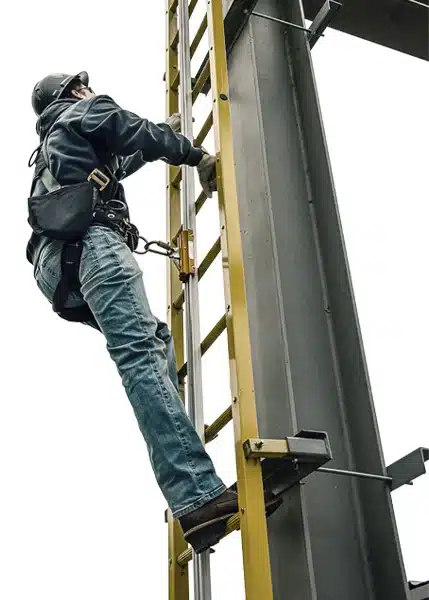
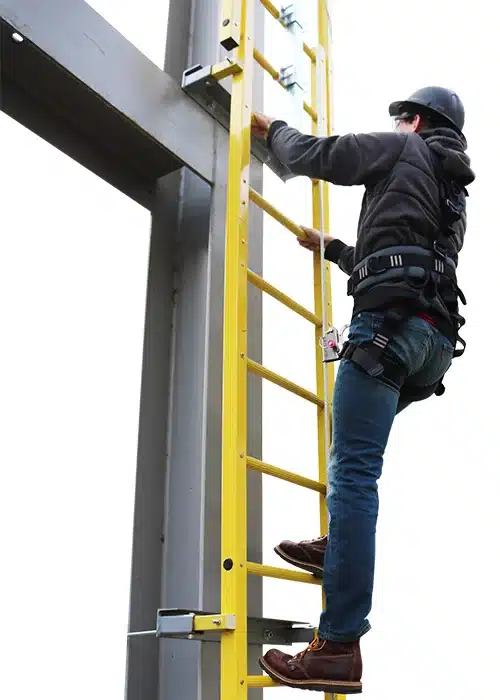
Why FC Safety Uses a Front Waist Connection
Key idea: A lower, centered connection can support natural movement and keep connecting hardware away from the upper body.
1. It Can Provide More Freedom of Movement
A front waist-level D-ring places the trolley or cable-grab connection lower on the worker’s body. This keeps the connecting hardware away from the upper chest and shoulders.
For compatible FC Safety systems, the lower and centered connection can help the worker move more naturally while:
- Climbing up the ladder
- Descending
- Reaching while remaining connected
- Performing limited work from the ladder
A properly designed ladder safety system should move with the worker. The climber should not have to continuously hold, push, or pull the trolley or cable grab to make it travel. OSHA requires ladder safety systems to allow the worker to climb up and down using both hands.
The actual amount of movement will depend on the ladder, harness fit, connecting hardware, climbing device, and work being performed.
2. It Keeps the Connecting Hardware Lower
A waist-level attachment places the main connector and related hardware farther from the worker’s upper chest, face, neck, and chin. This can reduce crowding and interference around the upper body.
It also allows the harness and climbing system to support the worker using the connection geometry for which the FC Safety system was designed.
That does not mean every chest-connected ladder system creates a face or neck hazard. Many systems are designed and tested specifically for a chest connection. Those systems must be used according to their manufacturer’s instructions.
Not Every D-Ring Near the Waist Has the Same Purpose
Key idea: Attachment points that appear close together are not interchangeable.
A full-body harness may have several attachment points that appear close together. They are not interchangeable.
Front Waist-Level D-Ring
A manufacturer-designated front waist D-ring may be used with a guided ladder safety system when the harness and climbing-system instructions approve that connection. This is the attachment used with the compatible FC Safety systems discussed in this article.
Hip or Side D-Rings
Hip D-rings are normally used as a pair for work positioning. They can help support a worker who is working on a vertical surface, but they are not intended to serve as the fall-arrest connection for a ladder safety system. Do not connect a ladder trolley or cable grab to a hip D-ring.
Rear-Waist Attachment
A rear-waist attachment is generally intended for travel restraint. Travel restraint prevents a worker from reaching a fall hazard. It is not intended to arrest a fall or serve as the connection point for a vertical ladder system.
Chest or Sternal D-Ring
A chest connection may be used for ladder climbing when the system is specifically designed and approved for it. Depending on the harness and equipment instructions, a chest attachment may also be used for work positioning, rope access, travel restraint, certain rescue operations, or climbing with an overhead self-retracting lifeline. The presence of a chest D-ring does not mean that it can be used with every ladder system.
Shoulder D-Rings
Shoulder D-rings are generally used as a pair for positioning, entry, retrieval, and certain rescue operations. They are not standard ladder fall-arrest attachment points.
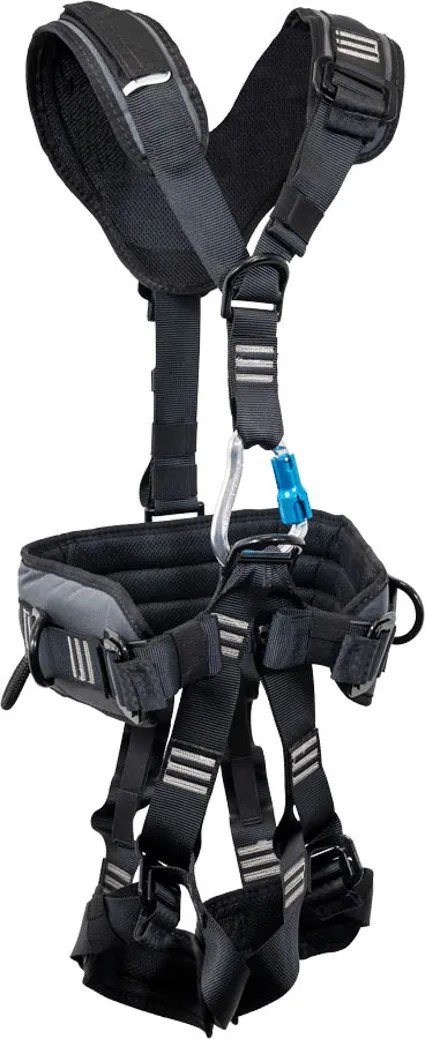
A Front Waist D-Ring Is Not a Body Belt
A front waist-level D-ring is part of a full-body harness. It is not the same thing as a standalone body belt.
A full-body harness is designed to support the worker across several areas of the body. A body belt only wraps around the waist. OSHA prohibits body belts from being used as part of a personal fall-arrest system.
Ladder safety systems are covered by separate criteria, so the required body support must always be determined by the instructions for the specific system. For the compatible FC Safety systems discussed here, use the approved full-body harness. Do not replace it with a body belt simply because both have an attachment near the waist.
Are Chest Connections Unsafe?
Key idea: No. Chest and waist connections are system-specific choices, not universal rankings.
No. A chest or sternal connection is not automatically unsafe. Many fixed-ladder systems are designed and tested specifically for connection to a chest D-ring. In those systems, the trolley or cable grab may be required to connect near the center of the chest.
Industry harness guidance recognizes both chest and front attachment points for certain guided ladder-climbing systems. The correct location depends on:
- The design of the climbing system
- The type of trolley or cable grab
- The harness construction
- The length and type of connector
- The expected direction and distance of a fall
- The manufacturer’s instructions
A waist connection is not universally safer than a chest connection. The two locations support and position the worker differently.
OSHA Requirements for Ladder Safety Systems
Key idea: OSHA establishes performance requirements for the complete system rather than declaring one universal harness connection location.
OSHA does not declare that every ladder system must use either a waist or chest connection.
Instead, OSHA establishes performance requirements for the complete ladder safety system. Among other requirements:
- The system must allow the worker to climb using both hands.
- The worker must not need to continuously hold, push, or pull the climbing device.
- The connection between the carrier or lifeline and the harness or belt attachment point cannot exceed 9 inches.
- The system and its supports must be capable of arresting a fall under the required test conditions.
Manufacturer instructions may be more specific than these general requirements. Always follow the instructions for the exact system being used.
Choosing the Correct Attachment Point
Key idea: Never select a D-ring simply because it is easy to reach.
A vertical ladder safety system includes several parts that must work together:
- The rigid rail or vertical cable
- The trolley or cable grab
- The connector
- The full-body harness
- The designated harness attachment point
Changing one part of that combination may affect how the entire system performs.
Before climbing, confirm the following:
- The harness is approved for the ladder system.
Check the harness label and the ladder-system instructions. - The correct D-ring is being used.
Confirm that the attachment point is specifically designated for vertical climbing. - The trolley or cable grab is installed correctly.
Confirm its orientation and connection before leaving the ground. - The connector is the correct type and length.
Do not add an extra lanyard, carabiner, or extension unless the instructions specifically allow it. - The harness fits properly.
Adjust the shoulder, chest, waist, and leg straps before climbing. - The equipment has been inspected.
Inspect the harness, connectors, trolley or cable grab, cable or rail, brackets, and other system components. - The worker has been trained.
Training should cover proper connection, climbing, inspection, equipment limitations, and emergency procedures. - A rescue plan is in place.
A fall-arrest system should never be used without a plan for promptly reaching and rescuing a suspended worker.
Frequently Asked Questions
Can I connect the ladder system to the hip D-rings?
Can I switch from the waist D-ring to the chest D-ring?
Is a front waist D-ring the same as a rear-waist D-ring?
Is a front waist D-ring the same as a body belt?
Does FC Safety recommend a waist connection for every ladder system?
Use the Attachment Point Approved for the Complete System
For compatible FC Safety rigid-rail and VL cable climbing systems, a manufacturer-designated front waist-level D-ring is intended to:
- Keep the connector centered and lower on the body
- Reduce interference around the chest and shoulders
- Support a more natural climbing position
- Allow smoother movement while ascending and descending
- Keep connecting hardware farther from the face, neck, and chin
This is a system-specific recommendation, not a universal rule that waist connections are always better than chest connections.
Always use the harness, connector, climbing device, and attachment point identified in the instructions for the complete ladder safety system.
This article provides general information and does not replace the instructions, inspection requirements, training, or rescue procedures for the equipment being used.